Online Tax Accountant - Why They're Better Than Going Into an Office
Fahad Gul • October 6, 2022

How Tax App - Online Accountants & Tax Agent can make your life easy!

Online Tax Accountant - Why They're Better Than Going Into an Office


Nowadays, there are so many things that you can do online. You can shop for groceries, clothes, and even furniture. So, why not use an online tax accountant? Here are four reasons why using an online tax accountant, like Tax App, is better than going into an office.


Convenience 


One of the best things about using an online tax accountant is that it's convenient. You don't have to take time out of your busy schedule to go into an office. You can do everything from the comfort of your own home. All you need is a computer and an internet connection 


Lower Cost  


Another reason why using an online tax accountant is a good idea is that it's usually cheaper than going into an office. This is because online tax accountants don't have the same overhead costs as brick-and-mortar businesses. They don't have to pay for office space, utilities, or other expenses. This savings is usually passed on to the customer in the form of lower prices 


Better Service 


When you use an online tax accountant, you usually get better service than you would if you went into an office. This is because online businesses know that they have to work a little harder to earn and keep customers. They're not relying on foot traffic or word-of-mouth to bring in business, so they have to provide excellent service to make sure that their customers are happy and will come back again in the future 


Privacy 


The final reason why using an online tax accountant is a good idea is that it's more private. When you go into an office, you often have to share a waiting room with other people who are there for different reasons. This means that people can overhear your conversations and see your personal information. When you use an online tax accountant, you don't have to worry about this because you'll be communicating with your accountant through a secure website or over the phone 


Conclusion 


Overall, using an online tax accountant has many advantages over going into an office. It's more convenient, private, and usually cheaper. Plus, you'll often get better service when you use an online tax accountant. So, if you're looking for a good way to prepare your taxes this year, consider using Tax App (Online Accountant & Tax Agents) instead of going into an office. You'll be glad that you did!


Leading Australian Accounting Expert & Author: Fahad Gul 


Fahad Gul is a Partner at Tax App Accountants and a recognised voice in the Australian Accounting industry, having been featured in Accountants Daily. A three-time winner of prestigious Australian Accounting Awards, Fahad is known for combining technical precision with practical commercial advice.


He specialises in helping Australian small business owners and investors navigate complex accounting and tax hurdles. Through his writing, Fahad shares the award-winning strategies necessary to optimise tax positions and accelerate wealth building.


Connect with Fahad on LinkedIn find out more on Tax App's website

Expert Australian Accountant and Author: Alesha Masaud 


Alesha Masaud is a recognised authority in Australian tax strategy and a Partner at Tax App Accountants, a firm that has secured three national Australian Accounting Awards. Personally recognised as one of Australia's Top 50 Business Leaders and a winner of the Accounting Excellence Award, Alesha combines technical expertise with real-world commercial acumen.


She writes to cut through the complexity of the Australian tax system, empowering small business owners and dedicated wealth builders with high-level strategies to legally minimize liabilities and maximise long-term growth.


Connect with Alesha on LinkedIn or learn more at Tax App Accountants.


Disclaimer:

The content of these blog posts is intended to be of a general nature and should not be construed as tax or any other form of advice. We do not guarantee the accuracy or completeness of the information provided in these blog posts. It is imperative that you consult with a qualified professional, such as a certified accountant at Tax App, before taking any action based on the advice or information contained herein. Your specific financial and tax situation may require personalised guidance, and a professional consultation is recommended to ensure compliance with applicable laws and regulations.


Get Started with Us

Connect with Australia’s most innovative accountants today. Fill out our contact form, and let’s discuss how we can help you achieve your financial goals. Together, we’ll create a tailored action plan that maximises your tax savings.


Our Awards! ⭐⭐⭐⭐⭐

innovative tax accountant
best accountant near me
sydney best tax accountant
sydney tax accountant best firm
award winning tax accountant sydney
top 50 small business tax leader

More blog posts

By Alesha Masaud July 3, 2026
 In the fast-evolving landscape of Australian real estate and finance, traditional methods are rapidly giving way to agile, technology-driven approaches. For business owners and sophisticated investors, navigating this shifting terrain requires more than just standard transactional support—it demands deep strategic advisory, cutting-edge systems, and structural precision. In this episode of the Business and Wealth Australia podcast, we sit down with Tom Carr , the founder of Wombat Home Loans . With over 20 years of experience across London’s elite investment banking sector and a pivotal role as a senior Product Owner for the Commonwealth Bank of Australia (CBA) app, Tom brings an unparalleled level of technological sophistication to the mortgage broking space. We dive deep into how he leverages advanced artificial intelligence (AI) and decentralized workflows to optimize client outcomes, the unique challenges facing expats and immigrants entering the Australian market, and the critical tax-structuring mechanics of debt recycling. From Banking Giant to Agile Disruptor: Tom Carr’s Journey Transitioning from a corporate banking giant to running an independent, elite advisory firm is no small feat. Tom’s background isn’t that of a typical mortgage broker. After a decade in London investment banking, he relocated to Australia and spent years driving digital transformation at CBA, specifically leading the deployment of AI, personalization, and data strategy for version 3 of the highly rated Combank app. However, corporate ecosystems often come with systemic friction. Tom identified an opportunity to take elite-level data frameworks and deploy them in a nimble, hyper-personalized environment to serve high-net-worth investors, business owners, and newly arrived professionals. Key Insight: Moving away from a corporate safety net forces true entrepreneurial iteration. The lack of a corporate buffer acts as a powerful catalyst for building lean, highly efficient automated systems that put client context at the absolute center of operations. Moving from Raw Data to Holistic Context Many business owners treat technology merely as a digital filing cabinet. Tom views technology as a core operational enabler. By leveraging Notion as the decentralized "heart" of his firm, alongside integrated AI models (including Claude, Gemini, and ChatGPT), Wombat Home Loans operates more like a high-growth fintech startup than a legacy brokerage. Building a "Semantic Context Lake" A common pain point for scaling businesses is information fragmentation across emails, text messages, WhatsApp, and specialized CRMs. Tom solved this by building a custom, automated data orchestration layer that syncs and synthesizes client communications twice daily. Automated Synthesis: Instead of wading through hundreds of disparate financial documents and emails, AI models process the raw inputs, extract compliance-heavy data, and generate holistic, high-level executive summaries. Streamlined Delegated Workflows: Using highly sophisticated permission-based architecture, global team members can collaborate seamlessly on marketing and pipeline optimization without compromising sensitive client financial data. Leveraging Human Capital: By outsourcing administrative data processing to automated systems, advisors can redirect 100% of their cognitive energy toward high-level strategy, client relationships, and complex deal architecture. Navigating the Australian Market as an Expat or Immigrant The Australian property market can be notoriously insular and opaque for those arriving from overseas. Immigrants and expats frequently experience a form of strategic paralysis; they lack the localized networks of trusted accountants, solicitors, and buyer's agents required to make confident moves. Furthermore, foreign income policy varies wildly across mainstream Australian lenders. Without an advisor who understands how to navigate cross-border tax structures and niche lending policies, international buyers are often hit with unnecessary rejections or suboptimal loan structures. Partnering with an advisory firm that understands the immigrant journey firsthand ensures that foreign income is accurately assessed and matched with the right banking institutions from day one. Wealth Acceleration: Debt Recycling vs. Equity Release For high-income earners and business owners sitting in the 30% to 45% marginal tax brackets, structural efficiency is the fastest way to accelerate wealth. During the episode, we analyzed one of the most underutilized strategies in mortgage finance: Debt Recycling . When executed correctly in tandem with an expert accounting team like TaxApp , debt recycling converts non-deductible personal debt (your owner-occupier home loan) into tax-deductible investment debt. Why Legacy Brokers Avoid Debt Recycling Because mortgage brokers are historically compensated via commissions based on total outstanding loan balances, true debt recycling, which focuses on aggressively paying down non-deductible loan components and building efficient splitscan be structurally disincentivised across the industry. Important Advisory Note: Proper structural execution is paramount. If loan splits, offset accounts, and investment flows are configured incorrectly, the Australian Taxation Office (ATO) can deny the deductibility of the interest. Wealth structures must be engineered accurately right from the outset by a coordinated team consisting of a tech-forward broker and your specialist accountant at TaxApp.  The Future of Professional Advice: The Modern Client The modern professional client is tech-forward, time-poor, and highly sophisticated. They do not want order-takers or legacy professionals who are drowning in physical paperwork and outdated compliance processes. The future of financial advisory belongs to agile specialists who use advanced systems to clear away operational bloat, leaving them free to provide what matters most: clear, transparent, and highly strategic human connection. To explore how to optimise your current lending structures, implement tax-effective investment splits, or map out an international wealth journey, connect with Tom Carr via Wombat Home Loans or view his professional insights directly on LinkedIn . Partner with Australias Trusted Tax Professionals As the leading Partners at Tax App Accountants , Alesha Masaud and Fahad Gul, CA have helped clients transform their annual tax obligations into opportunities for wealth preservation. Tax App Accountants combine expert credentials, industry authority, and a commitment accuracy for business owners and investors to deliver the best results for clients. While Tax App Accountants' physical office is located in the heart of Sydney, Lane Cove, our financial expertise knows no borders. We proudly serve a diverse portfolio of clients all across Australia, utilising modern, seamless technology to deliver top-tier accounting and advisory services wherever you are located. Office: Lane Cove, Sydney, NSW (Servicing Clients Nationwide) Phone: 02 8074 7774 Email: customerservice@taxapp.com.au Website: www.taxapp.com.au
By Alesha Masaud July 3, 2026
 As the 2026 financial year draws to a close, Australian taxpayers, investors, and business owners are looking for smart, legal ways to streamline their compliance and boost their refund. But navigating the Australian Taxation Office's ever-changing rules takes more than guesswork — it takes strategy and real-world experience. That's why we've put together this practical checklist to help you get your records in order before you lodge. Save it, work through it item by item, and walk into tax time prepared. Work-Related Deductions If you spend your own money to do your job, there's a good chance some of it is deductible. Start gathering evidence for: Vehicle and travel — a logbook or calculated business kilometres for any private car used for work Commercial vehicles — total running costs and usage logs for a work ute, van, or motorbike Home office expenses — a record of hours worked from home, so you can claim via the fixed-rate or actual-cost method Phone and internet — records showing the work-related proportion of your usage Tools and equipment — receipts for anything physical you need to do your trade or job Uniforms and protective clothing — costs for occupation-specific uniforms or safety wear Sun protection — sunscreen, hats, and UV glasses if your job has you working outdoors Professional development — course fees, conference registrations, and seminar costs Memberships — professional association or union fee receipts Subscriptions — invoices for industry journals or trade publications used for work Assets and Depreciation A simple rule of thumb: items under $300 can be claimed in full immediately , while anything over $300 needs to be depreciated over its effective life. Keep records for: Laptops, tablets, and phones used for your occupation Secondary monitors, printers, or scanners Office furniture — ergonomic chairs, desks, or full home-office setups Network hardware — modems and Wi-Fi routers Storage — dedicated filing cabinets or work storage systems Content creator gear — camera rigs, lighting, and audio equipment Vehicles depreciated using the logbook method General and Investment Deductions Accounting fees — last year's tax preparation invoice Investment or debt-recycling loan interest — for loans tied directly to a share portfolio or investment property Account fees — monthly fees on investment-specific bank accounts Portfolio expenses — ongoing share portfolio or dividend management fees Income protection premiums — for policies held outside super Charity donations — receipts for gifts over $2 to registered Deductible Gift Recipients (DGRs) Superannuation Wealth Strategies Super contributions can be one of the most effective ways to reduce your taxable income while building long-term wealth: Concessional (voluntary) contributions made personally into your super Catch-up contributions , using any unused concessional cap from previous years Just remember: you'll need a valid Notice of Intent to Claim a Deduction lodged with your super fund before you can claim these. Must-Have Records Good deductions start with good records. Before tax time hits, make sure you have: A digital log of every receipt and invoice, so nothing gets lost Income evidence — group certificates, bank interest statements, and dividend summaries Don't Leave Money on the Table This Financial Year Getting organised now means less stress later — and a better outcome when you lodge. If you'd like a professional set of eyes on your return, our team is here to help you turn tax time into an opportunity for genuine wealth preservation. Get in touch: Lane Cove, Sydney, NSW (servicing clients nationwide) 02 8074 7774 customerservice@taxapp.com.au www.taxapp.com.au
By Fahad Gul July 1, 2026
If you run a small business, you already wear a dozen different hats. You’re the CEO, the head of marketing, the customer service rep, and the janitor. But when it comes to being your own payroll department, things can get surprisingly overwhelming. One of the most common questions entrepreneurs ask themselves is: "Should I take a salary, or should I take dividends?" Usually, this question sends us spiraling down a rabbit hole of complex math, tax brackets, and spreadsheet anxiety. But if we strip away the jargon and just look at your daily cash flow, it really doesn’t need to require an advanced finance degree. Let’s take the headache out of paying yourself with a super simple, highly effective cash flow trick. Step 1: The Salary vs. Dividend Split Instead of looking at salary and dividends purely as tax strategies, try looking at them as two distinct tools for managing your life. One is for today, and the other is for tomorrow. 💸 Salary = Your Everyday Life Your salary is your survival fund. It’s the reliable, steady income you need to keep your household running without a hitch. How to use it: Sit down and calculate exactly what you need to cover your bare-bones essentials. We’re talking about your rent or mortgage, your utility bills, and your groceries. (And yes, taking the family out for a camping trip twice a year absolutely counts as a basic essential!) Whatever that magic number is, pay it to yourself as a regular, predictable salary straight into your main transaction account. Knowing your basic living expenses and family time are handled month after month is the ultimate stress reliever. 📈 Dividends = Your Future Now, what about the money you want to put toward building your wealth? This is where dividends shine. How to use it: Any money you want to use for saving, investing, buying real estate, or building a nest egg should be treated as dividends. The golden rule here is to never let this money mix with your grocery cash. Send your dividends directly to a completely separate investment or savings account. By physically separating your wealth-building money from your everyday money, you ensure it’s ready to be put to work, rather than accidentally spent on a spontaneous weekend trip. Step 2: Master Your Money with the "Box Method" Once you have your salary hitting your personal bank account, it's time to organize it. This brings us to my absolute favorite personal finance trick: Thinking in boxes. Personal finance gets incredibly messy when all your cash is sitting in one giant pile. Imagine throwing your socks, shirts, pants, and shoes into one giant laundry basket instead of a dresser. Every time you need to get dressed, you have to dig through the whole pile to find what you need. Your money works the same way. The more you have to dig through a single bank account to figure out what you can afford, the more complex and stressful it feels. Setting Up Your Financial Boxes 📦 Instead of one giant checking account, set up multiple, fee-free bank accounts with very specific jobs. Give every dollar a clear home. Box 1: The Non-Negotiables 🏠 This account is sacred. It is strictly for your rent or mortgage, electricity, water, and insurance. The money goes in, the direct debits come out, and you never use the debit card attached to this account for anything else. Box 2: Everyday Fuel 🛒 This is your daily spending account. It holds the budget for your groceries, your morning coffee, and putting gas in the car. When this account runs dry, you know you need to eat leftovers from the fridge! Box 3: Subscriptions and Fun 🍿 Netflix, the gym, Spotify, that software you forgot you subscribed to—put them all here. By isolating your subscriptions, you can easily see exactly how much you are spending on them every month, making it super easy to audit and cancel the ones you don't use. Box 4, 5, 6... And More! ➕ The beauty of this system is that you can build as many boxes as you need. Want a dedicated account just for pet expenses? Build a box. Need a separate account for date nights? Build a box. Customize it until it fits your life perfectly. Why This Simplifies Everything When everything is in its own box, the complexity completely disappears. You never have to log into your banking app, look at a large lump sum, and try to do mental gymnastics to figure out if you can afford to go out for dinner without bouncing your mortgage payment next week. You know exactly what you have, exactly where it belongs, and exactly what it’s meant to do. It leaves you with way less financial anxiety and way more energy to focus on what you do best: growing your business. 🚀 (P.S. While this is an incredibly effective strategy for managing your personal cash flow and reducing stress, you should always give your accountant a quick shout! They will help you make sure your salary and dividend split is set up perfectly for tax season.)
By Fahad Gul June 27, 2026
All In or Nothing: 19 Hard Lessons from Building a Profitable Accounting Firm Most business coaches will tell you to "test the waters" and "keep your options open" when starting a business. They preach the safety of a safety net and tell you to build your business on the side until it feels secure. I tell my clients the exact opposite. The honest truth is that Tax App was never going to be successful until I went all in. Our mission is saving Australian business owners thousands in tax and empowering them to make financially sound decisions , but the gap between a struggling side hustle and a profitable firm capable of delivering on that promise isn't a lack of skill or market demand. It's a lack of commitment. Here is the honest trajectory of our growth: 2022–2023 (Side hustle + corporate job): Ran at a loss. 2023–2024 (Went "all in"): Nearly covered my wage. 2024–2025 (Alesha joined): Fully paid my wage, partly paid hers, small profit. 2025–2026 (Focused scaling): Both on above-market wages + healthy profit. Getting from that initial loss to paying above-market wages wasn't magic. It was built on a foundation of trial, error, and uncompromising standards. Whether you are an accountant, a founder, or a professional looking to scale, here are 19 hard lessons I learned from the trenches. Phase 1: Mindset and Work Ethic You cannot build a formidable business with a casual mindset. The foundation of your success is dictated by where and how you work. Commit fully: You can't successfully split your energy between a demanding corporate role and your own firm in the exact same industry. You end up doing a disservice to both your employer and your own clients. Pick one and burn the boats. Get an office: If your industry is office-based, get a physical space as soon as you can. No, it is neither cool nor the peak of 'work-life balance' to work from your living room. The physical separation is vital: the office is for work, and the home is for family. Productivity over comfort: If your role requires more than swiping on a tablet, you need to be in the office unless you are feeling a little unwell. The same goes for your team. Real, heavy-lifting accounting and strategic work requires a dedicated environment with proper multi-screen setups. Hold your team to this standard. Stay on the tools: Forget playing the untouchable CEO in an ivory tower. I still handle client work, and I still clean the office on weekends. Staying grounded keeps you connected to the reality of your business, your team's friction points, and your clients' actual needs. Family first: Full stop. You build the business to support the family, not the other way around. Never lose sight of this priority. Phase 2: Client and Brand Experience How you present yourself and treat the people who walk through your door will make or break your reputation in this industry. Invest in first impressions: Never cheap out on your website or your business cards. In a digital-first world, these are your storefronts. You only get one shot to look like a professional. Either take the time to learn to build them well yourself, or pay a pro to do it right. Respect every client: A very basic, entry-level tax client once referred a massive $20K/year account to us. If I had treated that initial small client as just a quick, low-value transaction, I would have lost out on a major opportunity. Treat everyone who walks through your door like your biggest account. Don't compete on price: The moment you try to be the "cheap option," you start a race to the bottom. Competing on price inevitably destroys your service quality because you have to take on too much volume to survive. Charge what you are worth and deliver immense value. Be the silver lining: There is a lot of fear, economic depression, and uncertainty out there right now. Don't add to the doom and gloom. Always be positive and be the person who shows your clients the clear, strategic road forward to success. Phase 3: The Technology Advantage The accounting industry is notorious for being bogged down by legacy systems. Leveraging modern tech is the fastest way to punch above your weight class. Out-innovate the giants: Big corporate firms are incredibly slow to adopt new technology. Their red tape is your window of opportunity. You can win their best clients simply by offering a vastly superior, frictionless digital experience. Explore niche software: Industry defaults and standard software packages aren't always the best fit for a modern firm. Dig deeper. Niche tools often offer far better UX, value, and specific features that the big generic brands ignore. Automate relentlessly: Play with APIs and actively seek out software that gives you access to their APIs. If you are doing manual data entry in 2026, you are wasting money. Automation saves time, preserves energy, and eliminates human error. Lock down your data: Cybersecurity and daily backups are non-negotiable. As accountants, we hold the keys to our clients' financial lives. If you lose their trust with their data, you lose your business overnight. Phase 4: Building and Leading a Team Accounting isn't always glamorous. Keeping a high-performing team motivated requires transparency, fair compensation, and proactive leadership. Reward in real time: Don't make your team wait until December for an annual bonus to get recognition. Pay regular bonuses and incentives dependent on how they actually helped the business right then and there. Reward wins as they happen. Incentivise idle time: If staff have quiet periods, don't let them sit idle. Getting the standard client work done is what they get paid their base salary for. Instead, reward them heavily for improving workflows and building internal tools. Innovation should be 50% of their KPIs. Combat the boredom: Let’s be honest, the day-to-day work of accounting can be boring. Always be radically transparent with your staff about the firm's growth trajectory and show them exactly how they can earn a management role. Give them a future to build toward. Phase 5: Finance and Strategic Growth Scaling too fast or tying up your money in the wrong places can kill a profitable business just as quickly as a lack of clients. Stay liquid: Cash is king. Too many business owners pull money out of their company to buy real estate. Treat your business as your primary investment over tying up substantial funds in property. Investing in liquid assets, like shares, should be prioritised to ensure your business always has the capital it needs to maneuver. Control your growth: Hyper-growth breaks things—it breaks your systems, your culture, and your client relationships. Pause, build a solid strategy, and reinforce your foundations before scaling ruins you. Slow and steady wins the race. Respect the veterans: I still spend time with near-retirement accountants. They might not be the most tech-friendly, but they have incredible, battle-tested business advice. Listen to them. However, a word of warning: don't rely on just one mentor. If you do, they will inevitably push you into their specific way of doing things, rather than helping you build your vision. The Bottom Line Building Tax App from a side hustle running at a loss to a thriving, highly profitable firm wasn't a matter of luck. It required drawing hard lines in the sand about how we work, who we hire, and how we treat our clients. If you are sitting on the fence with your own business, waiting for the "perfect time" to transition from your day job—stop waiting. Go all in.

By Alesha Masaud May 13, 2026
The 2026 Australian Federal Budget: A Paradigm Shift in Australian Wealth Structuring
By Alesha Masaud March 23, 2026
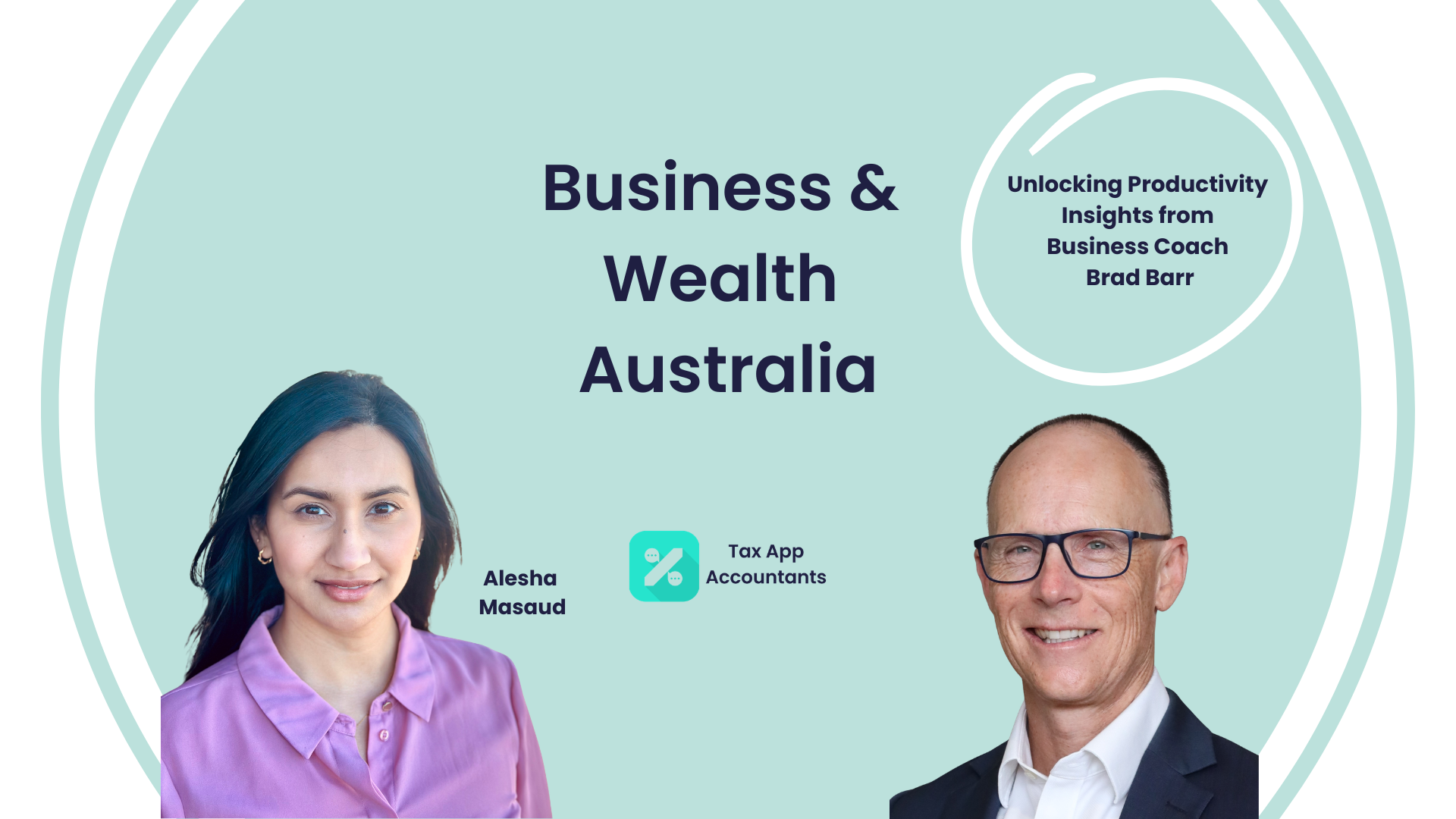
In the world of Australian entrepreneurship, "busy" is often treated as a badge of honor. When asked how business is going, the default response is almost always, "We’re flat out!" But is being busy actually the same as being successful? In this episode of the Business and Wealth Podcast, host Alesha Masaud (Partner at Tax App Accountants ) sits down with Brad Barr, an esteemed executive and business coach from Primed Leadership. Together, they deconstruct why business owners equate activity with productivity and how this mindset might be masking serious profitability issues.
By Alesha Masaud March 22, 2026
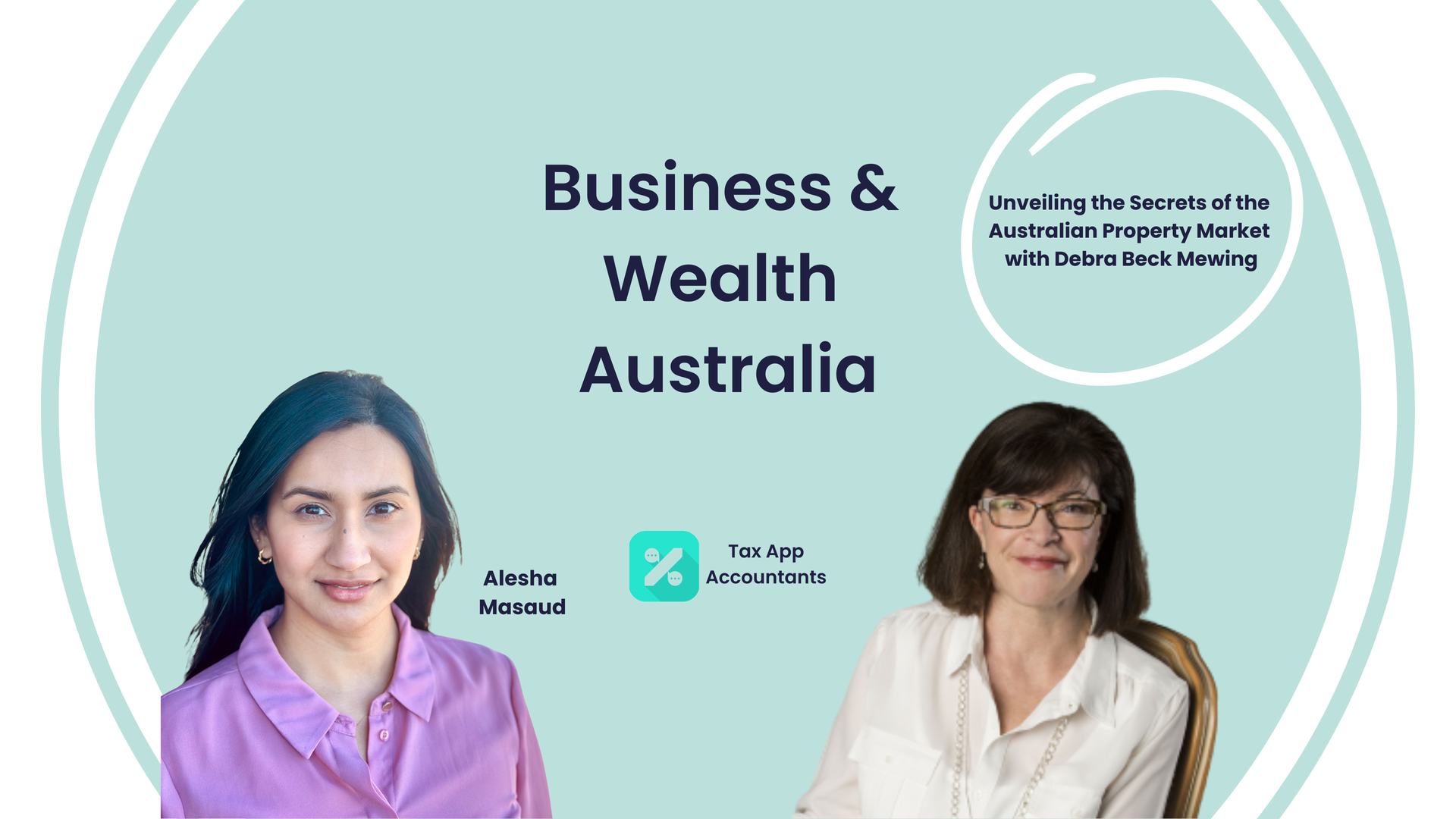
In the latest episode of the Business and Wealth Australia podcast, Alesha Masaud sat down with Debra Beck-Mewing, the founder of The Property Frontline , to pull back the curtain on how professional buyers' agents identify "hidden gems" in the Australian property market. With a background in global corporate law and accounting firms and a certification as a Qualified Property Investment Advisor (QPIA), Debra brings a data-driven, clinical approach to property—balanced with a deep understanding of the human elements of negotiation.
By Alesha Masaud February 27, 2026
Welcome to a thought-provoking exploration of the current global market dynamics as seen through the lens of AI innovation and political influences. In a recent episode of the Business and Wealth Australia podcast, Alesha Masaud from Australia's leading Business Accountants Tax App Accountants sat down with Nick Walter of Walter Wealth to dissect the intricacies of the financial landscape. Understanding the 2025 April Dip Nick Walter addresses the market volatility that surfaced with the April dip. This downturn was primarily attributed to former President Trump's tariff-related policies, sparking widespread concern. Walter reflected on the surprise tariffs implemented on what Trump termed "Liberation Day," which unsettled both allies and market watchers worldwide. He highlighted the fear and hesitancy the tariffs induced, eventually leading to a temporary market respite when a 90-day pause was announced. Local Implications for Australia Bringing the conversation closer to home, Nick emphasized the interconnected nature of global and Australian markets. Every Australian employee is indirectly involved in global trends through superannuation investments. Despite the absence of a tech sector on par with the US, Australian assets, particularly in finance and conservative industries, offer a more stable yet slower growth trajectory. US versus Australian Market Dynamics Nick and Alesha explored the contrasting pillars of the US and Australian markets. The US tech industry is a dominant market force, unlike Australia’s financial service-centric market led by major banks. This divergence was starkly reflected in the disparity of growth rates; the NASDAQ's impressive 20% gain over the past year outpaced Australia's modest 9%. The AI Surge: Bubble or Boom? Addressing a topic that piqued many interests, the duo explored the burgeoning AI industry. Nick acknowledged the significant financial investments by US tech giants like Nvidia, Google, and Microsoft into AI, characterizing the current momentum as a hopeful surge ripe with potential rather than a bubble poised to burst. He did draw parallels to the .com boom of the late '90s, noting how innovation often follows periods of intense speculation and subsequent market correction. Investment Strategies in Evolving Markets Nick shared invaluable advice on handling risk in a potentially overheated AI sector. While tech companies reach unprecedented valuations, diversified investment remains key. He urged investors to diversify beyond the share market, considering less volatile options like property or infrastructure. The Role of Financial Advice Underscoring the complexity of assessing financial landscapes, Alesha stressed the importance of consulting seasoned financial advisors. Nick Walter extending an open line for inquiries, reaffirming the importance of aligning investment strategies with individual financial goals and circumstances. Conclusion The podcast concluded with an appeal for balanced, informed investment: urging listeners to seize opportunities without succumbing to hype. By weaving through global and local economic narratives, Nick and Alesha delivered a rich tapestry of insights, grounding the intricate dance of AI advances, market shifts, and financial strategies into practical, digestible guidance. For those looking to dive deeper, you can contact Nick Walter directly through Walter Wealth . Embark on this financial journey well-informed, and may your investment horizons broaden and inspire.
By Alesha Masaud December 14, 2025
Starting a business is a thrilling endeavour, filled with opportunities to explore, learn, and grow. For those ready to take the leap, it's crucial to lay a solid foundation to ensure success and sustainability. In a recent episode of the Business and Wealth Australia podcast, Alesha Masaud and business coach Simon Crisp delved into five key areas every aspiring entrepreneur should focus on before launching their business. Here’s their conversation and a breakdown of their insightful discussion.
More Posts